
Signs Your Car AC Compressor Is Failing
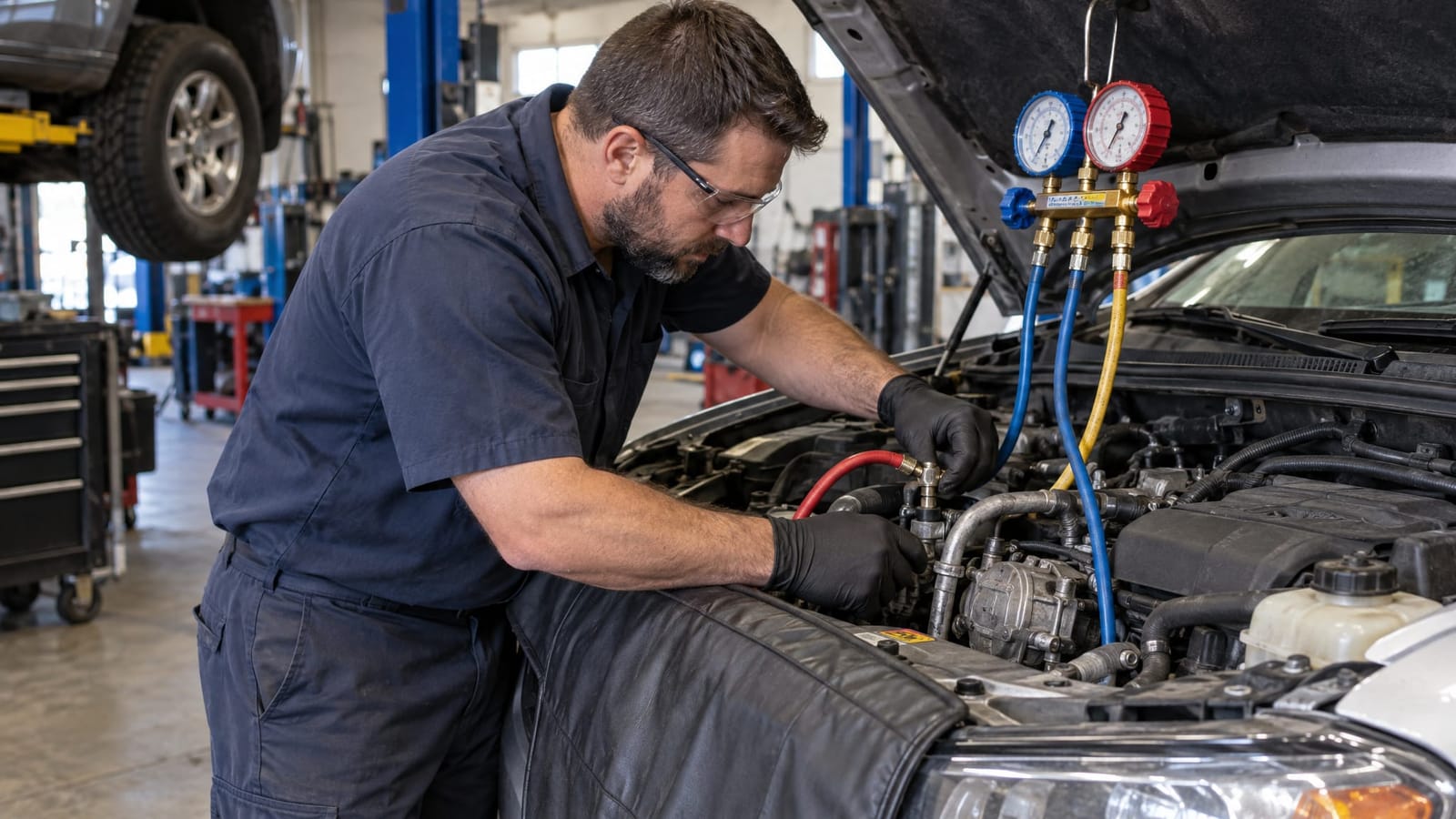
Warm air from the vents, loud grinding when the AC runs, cooling that comes and goes, and visible compressor clutch damage can all point to a failing car AC compressor. But none of these symptoms proves the compressor needs replacement. Refrigerant leaks, electrical faults and airflow problems can produce similar complaints.
The compressor circulates refrigerant through the AC system so it can remove heat from the cabin. It does not blow air through the vents. Understanding that difference helps separate a compressor problem from other cooling issues. These tips explain what to notice, what the symptoms can mean and what matters before approving a repair.
1. Separate a normal engagement click from grinding or repeated loud clicking
On a vehicle with a conventional AC compressor clutch, a brief click as the compressor engages can be normal. The clutch connects the compressor to the engine’s belt drive when cooling is needed. A single engagement click is different from persistent grinding, scraping or loud metallic clicking.
Pay attention to when the sound happens:
- Noise begins when the AC turns on: The compressor or clutch may be involved, but other components operating with the AC also need checking.
- Repeated clicking comes with uneven cooling: The system may be switching the compressor on and off because of refrigerant pressure or an electrical problem.
- Noise changes mainly with cabin fan speed: The blower fan deserves attention rather than assuming the compressor is responsible.
Some compressor cycling is normal. What matters is a change from the vehicle’s usual operation, particularly when the noise appears alongside a loss of cooling.
2. Track when intermittent cooling happens
An AC system that cools one moment and blows warm air the next can have a compressor-related fault. For example, a clutch or electrical connection may stop working consistently as components heat up. However, low refrigerant, pressure controls and cooling-fan problems can also interrupt cooling.
The pattern gives the diagnosis a useful starting point. Notice whether the AC:
- Works after startup, then loses cooling later in the drive.
- Cools while moving but becomes warm at stoplights.
- Changes suddenly between cold and warm air.
- Returns to normal after the vehicle has been parked.
If cooling improves at road speed but weakens while stopped, airflow through the condenser, the heat-releasing component near the radiator, is one possibility. That pattern does not automatically mean the compressor is worn out. Describing the conditions is more useful than simply reporting that the AC “sometimes works.”
3. Distinguish warm air from weak airflow
A compressor that cannot circulate refrigerant effectively may leave you with strong airflow that never gets cold. The cabin fan still works, but the AC system is not removing enough heat.
Warm air can also result from a refrigerant leak, an electrical control fault or a temperature-control door inside the dashboard that is not moving correctly. Even a compressor that appears to be running may need testing to establish whether it is working properly.
Weak airflow is a different clue. If little air comes through the vents, a restricted cabin air filter, blower problem or ice buildup inside the system may be involved. Weak airflow alone is not a strong reason to replace the compressor.
A useful description separates the two issues: “The fan blows strongly, but the air stays warm,” or “The air feels cold, but very little comes out.” Those observations lead to different checks.
4. Treat clutch damage as an inspection finding, not a complete diagnosis
On compressors equipped with a clutch, an inspection may reveal cracked or missing clutch pieces, visible heat damage or a pulley that does not run straight. These findings can point to a clutch or pulley problem without proving that the compressor’s internal parts have failed.
A pulley bearing can also make noise with the AC switched off. On a conventional clutch-equipped system, the engine belt still turns the pulley even when the clutch is not driving the compressor.
A clutch that does not engage is not necessarily broken. The system may be withholding power because of refrigerant pressure, a wiring fault or another control issue. Some compressor designs do not use a conventional visible clutch, so watching for engagement is not a universal test.
Hands-on checks involve moving belts and pressurized refrigerant. Those checks belong with our repair team rather than a driveway test.
5. Look for testing that separates compressor failure from other faults
A sound diagnosis connects the symptom to the cause. Warm vents or a non-engaging clutch, by themselves, are not enough to establish that a compressor needs replacement.
Depending on the vehicle and complaint, the diagnostic process can include:
- Checking cooling performance: Compare vent temperature and system behavior under the conditions that bring on the problem.
- Checking refrigerant charge and leaks: Too little refrigerant can reduce cooling and cause the system to interrupt compressor operation.
- Testing electrical operation: Check whether the compressor receives the power or control signal it needs.
- Evaluating system pressures: Interpret pressure readings alongside operating conditions and the vehicle’s compressor design.
- Inspecting related components: Check the belt drive, cooling fans and airflow through the condenser.
Refrigerant is not normally consumed during AC operation. When the charge is low, finding the reason matters more than repeatedly adding refrigerant. Likewise, oily residue near a compressor connection can be a clue to a leak, but residue alone does not identify the exact leak location.
A helpful explanation of the diagnosis identifies both the failed part and the evidence behind that conclusion.
6. Understand why compressor replacement can be expensive
The compressor is often one of the more expensive AC repairs, but it is not always the costliest component to replace. For example, an evaporator located deep inside the dashboard can require substantial labor. The vehicle’s design and the extent of the fault determine the total repair cost.
The component and installation work
A compressor contains precision moving parts that operate under pressure. Some designs also include a clutch or electronic controls. The replacement part therefore represents more than a simple pulley or motor.
Installation involves more than removing one component and attaching another. Compressor replacement requires refrigerant recovery, access to the compressor, attention to the correct lubricant and seals, removal of air and moisture from the system, and recharging to the vehicle’s specified amount. Access can be straightforward on one vehicle and much more involved on another.
Contamination and related components
If an internal compressor failure spreads metal debris through the AC system, replacing only the compressor can leave contamination behind. That debris can damage the replacement or restrict refrigerant flow.
The repair may therefore include cleaning suitable components or replacing parts that cannot be adequately cleaned, following the vehicle-specific procedure. A moisture-removing component, called a receiver-drier or accumulator depending on the system, may also be part of the repair.
Not every compressor fault creates contamination. An estimate is more useful when it explains why each related part or procedure is included instead of treating every AC problem as the same repair.
7. Compare the repair scope, not just the compressor price
A faulty electrical connection calls for a different repair than a compressor with internal mechanical damage. A clutch-only repair may be possible on some vehicles when testing supports it and the clutch is serviceable separately. On others, replacing the compressor assembly is the appropriate approach.
Before approving work, useful questions include:
- What test result points to the compressor rather than another component?
- Is the fault inside the compressor, in the clutch or in its electrical supply?
- Was a refrigerant leak or contamination found?
- What related work is included, and why?
- How do diagnosis, parts and repair labor affect the expected completion time?
These distinctions also help with transportation planning. An external electrical repair and a compressor replacement involving system cleaning have different work requirements. A repair-time estimate is most meaningful once the scope is clear.
At Jordan Auto Repairs and Tires Plus LLC, we offer AC repair and vehicle electrical system diagnostics here in Jacksonville. We focus on honest explanations, dependable work and a quick turnaround, with the repair guided by what the diagnosis shows.
The key takeaway: symptoms narrow the search, testing identifies the repair
Grinding noises, intermittent cooling, warm vents and clutch damage deserve attention, but they do not all lead to compressor replacement. Note when the problem happens, distinguish airflow from cooling performance, and look for a clear explanation of the test findings. That makes it easier to understand the repair and avoid paying for a major component based on symptoms alone.